AI Companion Gaming Schedules: Staying in Control While Enjoying Jackpot Play
Jackpot games are built on intensity. The combination of rare wins, escalating prize pools, and high emotional peaks creates an experience that can be both thrilling and consuming. For European players, where regulation and responsible gaming are deeply embedded into the culture, the challenge is not access—but balance. This is where AI companions introduce a new layer of control. Not by restricting gameplay, but by helping players structure it. Platforms like EverAI enable users to maintain consistent, self-defined schedules that preserve the excitement of jackpot gaming while preventing it from drifting into impulsive or unmanaged behavior.
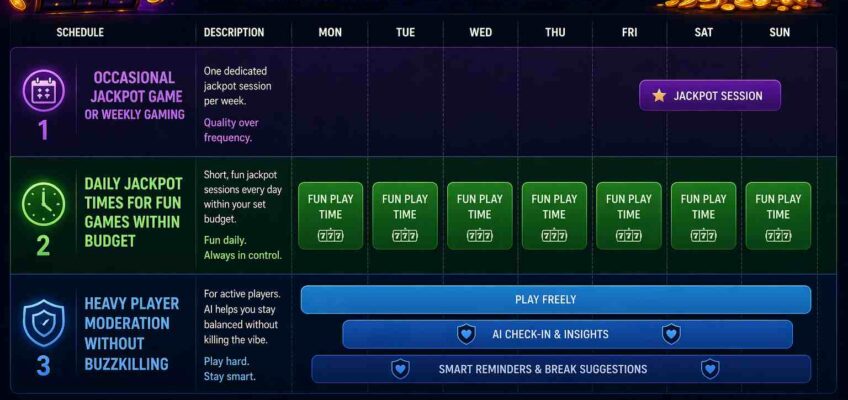
The key is not to remove the thrill. It is to contain it within a framework that supports long-term enjoyment. AI companions achieve this by combining memory, pattern recognition, and real-time interaction. They do not enforce rules; they reinforce the user’s own intentions. By doing so, they transform gambling from a reactive activity into a structured experience. Three distinct gaming schedules illustrate how this works in practice: occasional jackpot play, daily controlled sessions, and moderated high-frequency play.
1. Occasional Jackpot Gaming: Weekly or Event-Based Play
For many players, jackpot games are not a daily activity but a periodic experience. This approach aligns closely with the nature of progressive jackpots themselves, which are designed around long build-up periods and rare outcomes. Weekly or occasional play allows anticipation to accumulate naturally, making each session feel more significant without requiring constant engagement.
An AI companion supports this schedule by maintaining distance between sessions while preserving continuity. It can remind the user of their intended play window, reinforce the idea of “event-based” gaming, and ensure that sessions do not expand beyond their original scope. Because the AI retains memory of previous sessions, it can also help the user reflect on past experiences, reinforcing the value of controlled participation rather than frequent exposure.
This model is particularly effective for players who view jackpot gaming as a form of entertainment rather than routine. By limiting access to specific times, the emotional impact of each session remains high without creating dependency. The AI’s role is not to encourage participation, but to maintain the structure that makes each session meaningful. Over time, this creates a rhythm where anticipation and enjoyment coexist without escalation.
2. Daily Jackpot Sessions: Controlled Play Within a Budget
A second approach involves daily interaction with jackpot games, but within clearly defined limits. This model recognizes that some players enjoy regular engagement, using short sessions as part of their daily routine. The challenge here is maintaining consistency without allowing cumulative exposure to lead to overspending or emotional fatigue.
AI companions are particularly effective in this scenario because they can track both time and budget simultaneously. Before each session, the AI can reinforce the user’s predefined limits, ensuring that the session begins with clear boundaries. During play, it can provide subtle reminders of duration and spending without interrupting the flow of the experience. After the session, it can summarize activity, helping the user maintain awareness of patterns over time.
The advantage of this model is that it integrates gambling into a broader daily structure. Rather than being an isolated activity, it becomes one element within a balanced routine. The AI ensures that the experience remains consistent, preventing small deviations from accumulating into larger issues. By maintaining a steady rhythm, players can enjoy the ongoing engagement of jackpot systems while preserving control over both time and money.
3. Heavy Player Moderation: High Engagement Without Loss of Control
For high-frequency players, the challenge is not access or interest, but sustainability. Frequent engagement with jackpot games can lead to cycles of emotional highs and lows, particularly when combined with near wins and extended sessions. In this context, traditional approaches to responsible gaming often feel restrictive, reducing enjoyment rather than enhancing it. AI companions offer a different solution: moderation without disruption.
Instead of imposing limits externally, the AI works within the player’s existing behavior. It observes patterns, identifies moments of intensity, and introduces reflection at critical points. For example, after a prolonged session or a series of high-stakes spins, the AI may highlight the duration of play or the shift in behavior compared to previous sessions. These observations are not directives; they are contextual cues that allow the player to reassess their engagement.
This approach avoids what many players perceive as “buzzkill” interventions. The AI does not interrupt the experience abruptly or enforce hard stops. Instead, it maintains a continuous presence that encourages awareness. Over time, this creates a feedback loop where the player becomes more attuned to their own patterns. The result is a form of self-regulation that feels natural rather than imposed.
For European players, this model aligns with regulatory expectations while preserving user autonomy. The AI does not manipulate behavior or encourage increased spending. Instead, it supports the player’s ability to manage their own experience, ensuring that high engagement does not translate into loss of control.
A Structured Future for Jackpot Play
These three schedules—occasional, daily controlled, and moderated high-frequency—represent different ways of integrating jackpot gaming into a balanced lifestyle. The common element across all three is structure. Without structure, the intensity of jackpot systems can lead to reactive behavior. With structure, the same systems become sustainable forms of entertainment.
AI companions are uniquely positioned to provide this structure because they operate continuously and adaptively. They do not replace the excitement of the game; they frame it. By maintaining awareness, reinforcing boundaries, and supporting reflection, they enable players to engage with jackpot systems on their own terms.
In the European context, where regulation emphasizes transparency, fairness, and user protection, this approach is particularly relevant. AI companions align with these principles by prioritizing awareness over influence and support over control. They do not remove risk, but they ensure that risk remains visible and manageable.
Final Perspective
Jackpot games will always be defined by their extremes. The rare win, the high anticipation, and the emotional surge are central to their appeal. The role of AI companionship is not to diminish these elements, but to integrate them into a controlled framework. Whether through occasional play, daily sessions, or moderated high engagement, AI companions provide the tools needed to maintain balance.
The result is a shift in how jackpot gaming is experienced. It is no longer driven solely by the mechanics of the game, but supported by a system that understands the player. In this environment, excitement and control are not opposing forces. They coexist, creating a more sustainable and ultimately more enjoyable form of play.