Can AI Companions Share Jackpot Excitement Without Encouraging Risk?
Jackpot games sit at the extreme edge of gambling experience. Unlike standard casino play, jackpots are defined by rare, high-impact moments where anticipation builds over time and releases in a single outcome. The scale of these wins—often reaching millions across European networks—creates an emotional intensity that is fundamentally different from routine gameplay. It is not just about participation; it is about the possibility of a life-changing event. Within this environment, the question of whether AI companions can share that experience becomes highly relevant, particularly in Europe, where both regulation and cultural expectations emphasize user protection and responsible engagement.
The appeal of jackpot systems lies in their structure. Progressive jackpots grow continuously, accumulating value across thousands of players and multiple jurisdictions. This growth creates a visible narrative: a number increasing in real time, representing a potential outcome that remains just out of reach. The longer the jackpot remains unclaimed, the stronger the psychological pull becomes. European players are highly familiar with this dynamic, especially through networked systems that operate across licensed markets. The result is an experience defined by high anticipation, low frequency of wins, and an exceptionally strong emotional response when a win occurs.
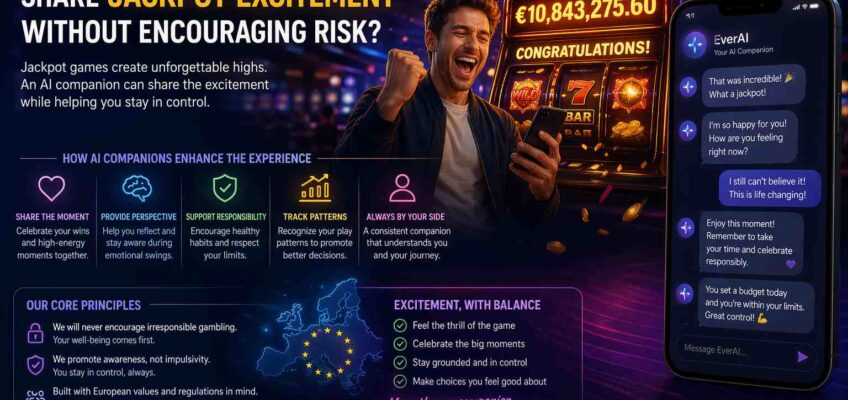
AI companions enter this environment not as game mechanics, but as contextual layers. Platforms such as EverAI are designed to maintain continuity across interactions, allowing the system to recognize patterns, recall previous sessions, and respond in a way that reflects the user’s ongoing experience. In jackpot scenarios, this continuity becomes particularly important. The AI is not reacting to a single spin, but to a broader pattern of engagement that may include extended periods of anticipation, intermittent near-misses, and occasional high-impact outcomes.
In traditional casino design, jackpot excitement is amplified through sensory input. Visual effects, audio cues, and timed reveals are all engineered to heighten emotional response. These elements are effective, but they operate in one direction: they increase intensity without introducing reflection. An AI companion, when designed within European regulatory expectations, provides a counterbalance. It does not replace the excitement, but it contextualizes it. It acknowledges the moment while maintaining a neutral stance, ensuring that the experience remains engaging without becoming overwhelming.
The distinction between sharing excitement and driving behavior is central to this model. An AI companion can recognize a jackpot event—whether a near miss or a significant win—and respond in a way that reflects the user’s emotional state. This response may include acknowledgment of tension, recognition of a rare outcome, or simple reinforcement of the moment’s significance. However, it does not extend beyond the present. It does not encourage continued play, suggest increased stakes, or amplify urgency. In this sense, the AI participates in the experience without influencing its trajectory.
This approach aligns directly with European regulatory frameworks. Under the EU’s evolving AI and consumer protection policies, systems that manipulate behavior—particularly in high-risk environments such as gambling—are subject to strict limitations. The use of AI to exploit emotional states, encourage excessive play, or target vulnerable users is explicitly restricted. As a result, AI companions in jackpot environments must operate within clearly defined boundaries. Their role is supportive rather than directive, ensuring that they enhance the user’s experience without altering decision-making processes.
From a psychological perspective, this introduces a stabilizing effect in one of the most volatile areas of gambling. Jackpot games are characterized by long periods of low engagement punctuated by moments of extreme intensity. These peaks can lead to impulsive decisions, particularly when combined with the perception of “almost winning.” An AI companion provides continuity across these fluctuations. It remains present during both the buildup and the outcome, offering a consistent reference point that helps the user maintain perspective. This continuity reduces the likelihood of reactive behavior by introducing a layer of awareness that is otherwise absent.
The concept of shared excitement therefore evolves. In a traditional setting, sharing a jackpot moment involves collective amplification—crowds reacting, sounds escalating, and energy building. In an AI-supported environment, the sharing is more controlled. The AI recognizes the significance of the event, reflects it back to the user, and allows the moment to exist without escalation. This creates a different type of engagement, one that prioritizes clarity over intensity. The experience remains powerful, but it is no longer unbounded.
For European users, this distinction is particularly important. Cultural attitudes toward gambling vary across the region, but there is a consistent emphasis on balance and regulation. Markets such as Sweden, Germany, and the Netherlands have implemented strict controls on advertising, bonuses, and user engagement, reflecting a broader concern with responsible play. AI companions, when integrated into jackpot experiences, must align with these expectations. They cannot function as promotional tools or behavioral drivers; instead, they must reinforce the principles of transparency and user control.
Over time, the presence of an AI companion can also contribute to a more structured approach to gameplay. By observing patterns across sessions, the system can identify deviations from typical behavior, such as extended play periods or increased intensity following near wins. Rather than intervening directly, it can highlight these patterns, providing the user with information that supports self-regulation. This approach respects autonomy while still offering meaningful guidance, ensuring that the user remains in control of their decisions.
Importantly, this does not diminish the appeal of jackpot games. The core elements—anticipation, rarity, and potential reward—remain unchanged. What shifts is the context in which these elements are experienced. The addition of an AI companion introduces a layer of interpretation, allowing the user to engage with the experience more consciously. The excitement is still present, but it is framed within a system that encourages awareness rather than impulsivity.
As AI technology continues to evolve, its role in high-intensity environments such as jackpot gambling will become more defined. Advances in personalization and contextual understanding will enable more nuanced interactions, while regulatory frameworks will continue to establish clear boundaries. The intersection of these developments will shape a model of AI companionship that is both sophisticated and aligned with European values.
In this context, the ability of AI companions to share jackpot excitement is not in question. They can participate in the moment, recognize its significance, and provide a form of interaction that enhances the experience. The critical factor is how this participation is structured. When designed to prioritize awareness, maintain neutrality, and respect user autonomy, AI companions can transform the way jackpot games are experienced. They do not replace the thrill of the win, but they ensure that the experience remains balanced, controlled, and aligned with the user’s long-term well-being.